The Global Fintech Fest 2026 is set to take place from September 9–11, 2026, at the Jio World Centre in Mumbai, India. More than just another fintech conference, GFF has become one of the most influential platforms where regulators, banks, fintech companies, technology leaders, investors, and innovators come together to discuss the future of global finance.
This year, the event theme focuses on building “Trusted, Connected, Global Systems for Inclusive Finance.”
That theme reflects a major shift happening across the financial technology landscape. The fintech industry is no longer only about digitizing payments, improving mobile banking, or launching faster lending platforms. The next phase is about building intelligent, programmable, secure, and globally connected financial infrastructure.
GFF 2026 is also becoming one of the important AI events in India for fintech leaders, technology teams, and businesses exploring the future of intelligent financial systems.
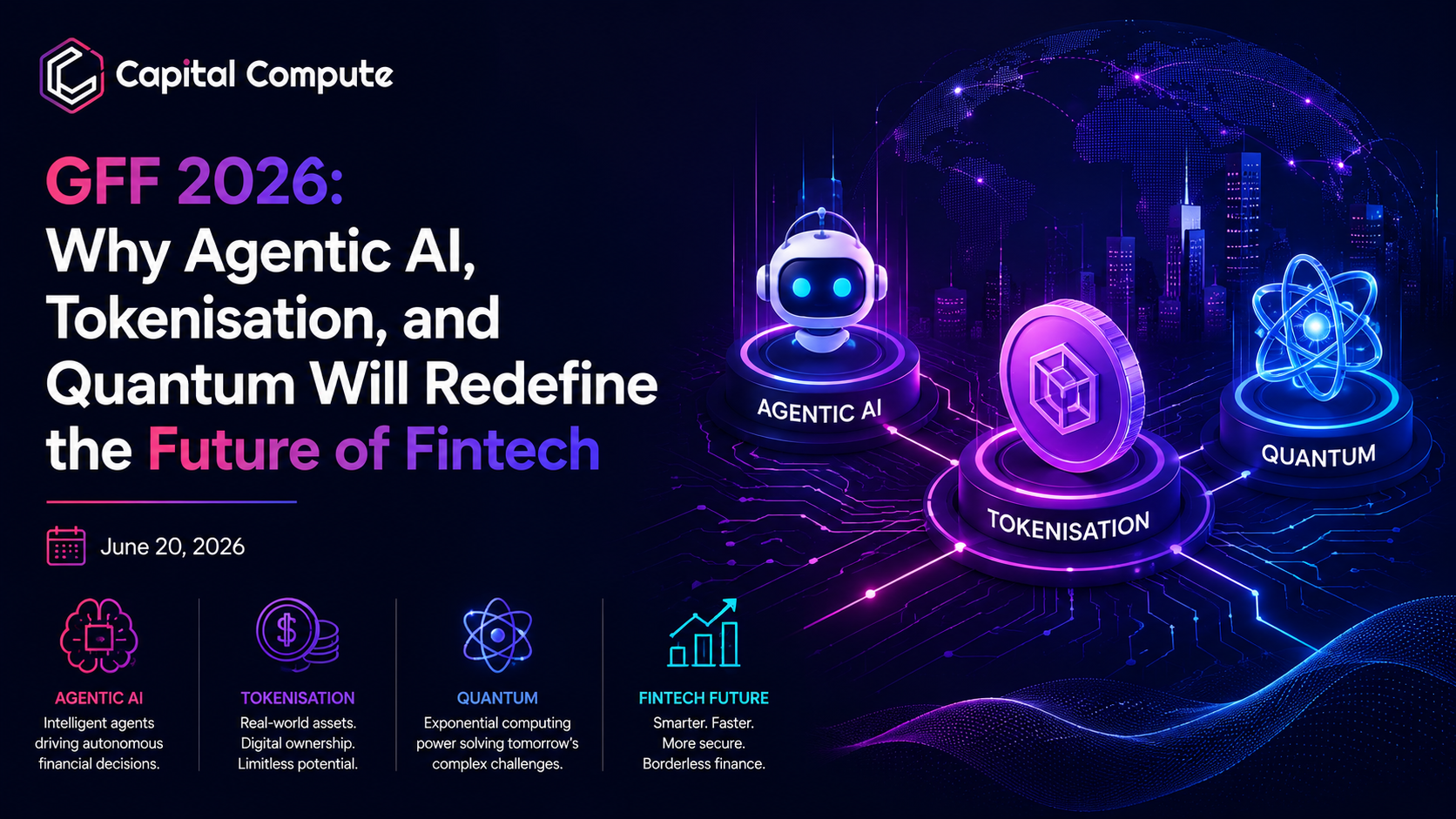
At the center of this transformation are three powerful technology pillars:
- Agentic AI
- Tokenisation
- Quantum Computing
For fintech businesses, banks, SaaS companies, and digital product teams, GFF 2026 is not only an event to watch. It is a signal of where the next wave of financial innovation is heading.
With its focus on AI, digital finance, and future-ready systems, GFF 2026 also reflects the growing role of AI in India and the need for stronger AI infrastructure across fintech platforms.
From Digital Finance to Autonomous Financial Systems
Over the last decade, fintech has changed how people pay, borrow, invest, insure, and manage money. Digital payments, mobile-first banking, API-based integrations, and embedded finance have already transformed customer expectations.
But the next stage of fintech will be very different.
Financial systems are moving from simple digital automation toward intelligent decision-making environments. Instead of platforms that only process transactions, the future will require systems that can understand context, detect risk, personalize services, automate workflows, and respond to market or customer behavior in real time.
This is where technologies like Agentic AI, tokenisation, and quantum computing become important.
These are not just buzzwords. They represent a deeper shift in how financial products will be designed, engineered, secured, and scaled.
Agentic AI: The Rise of Intelligent Financial Operations
Artificial intelligence has already entered fintech through chatbots, fraud detection, credit scoring, customer support automation, and recommendation engines.
However, Agentic AI goes further.
Agentic AI refers to intelligent systems that can act with a higher level of autonomy. These systems can analyze data, make decisions, coordinate workflows, and execute tasks with minimal human intervention.
In fintech, this could unlock major possibilities such as:
- Real-time fraud detection and prevention
- Automated compliance monitoring
- Personalized banking journeys
- Intelligent credit risk analysis
- AI-powered customer support
- Automated financial advisory systems
- Faster underwriting and loan approvals
Smarter internal operations for banks and fintech firms
For financial institutions, Agentic AI can reduce manual workload and improve decision speed. For fintech startups, it can help build smarter products with leaner teams. For customers, it can deliver more personalized, secure, and responsive financial experiences.
However, building AI-powered fintech systems requires more than adding an AI feature to an existing platform. It requires strong architecture, secure data pipelines, scalable backend systems, reliable APIs, and well-designed user experiences.
This is where product engineering becomes critical.
Tokenisation: Making Financial Value More Programmable
Tokenisation is another major theme shaping the future of fintech.
At its core, tokenisation allows real-world or digital assets to be represented as programmable digital tokens. These assets can include financial instruments, real estate, commodities, invoices, carbon credits, loyalty points, or even ownership rights.
The potential impact is significant.
Tokenisation can make assets:
- More divisible
- Easier to transfer
- More transparent
- Faster to settle
- More accessible to global participants
- Better suited for programmable financial products
For example, tokenised assets could enable fractional ownership, instant settlement, borderless asset transfer, and new models for digital investment platforms.
For fintech companies, this creates new opportunities in wealthtech, capital markets, lending, compliance, asset management, and cross-border finance.
But tokenisation also introduces technical complexity. Platforms must handle secure identity verification, transaction logic, wallet integrations, compliance workflows, audit trails, and scalable infrastructure.
A tokenised fintech platform cannot be built with weak architecture. It needs careful planning from the very beginning.
Quantum Computing: Preparing Finance for a New Security Era
Quantum computing may still feel futuristic, but its relevance to fintech is growing.
Financial services depend heavily on encryption, data security, optimization, and high-speed computation. As quantum technologies evolve, they could create both opportunities and risks for the industry.
On one side, quantum computing could improve complex calculations, portfolio optimization, risk modeling, and large-scale data processing.
On the other side, it raises serious questions about cybersecurity and encryption. Financial systems will need to prepare for quantum-safe cryptography and stronger security frameworks to protect sensitive financial data.
For fintech businesses, this means security can no longer be treated as a final-stage checklist. It must be embedded into product architecture, infrastructure planning, and development workflows from day one.
The companies that prepare early will be better positioned to build trust in a financial ecosystem where security, resilience, and compliance matter more than ever.
Why GFF 2026 Matters for Fintech Businesses
For technology leaders, GFF 2026 offers more than event updates. It creates space for conversations around fintech innovation, emerging AI use cases, and the impact of new AI technology on financial products.
For startups, it offers visibility, networking, investor access, and a chance to understand what the market will demand next.
For banks and financial institutions, it provides a view into emerging technologies, policy direction, digital public infrastructure, and strategic partnerships.
For technology companies, it highlights where product engineering, AI development, cybersecurity, cloud infrastructure, and scalable software systems will be needed most.
For a deeper look at how India’s technology ecosystem is evolving, read our related insight on Mumbai Tech Week 2026 key takeaways.
The event’s focus on AI, tokenisation, and quantum computing shows that fintech innovation is becoming deeply technical. Winning in fintech will not only depend on having a strong idea. It will depend on how well that idea is engineered into a reliable, secure, and scalable product.
While GFF 2026 is primarily a fintech event, its focus on Agentic AI, automation, and intelligent infrastructure gives it the feel of a global AI summit for the financial technology industry.
What This Means for Fintech Product Development
The next generation of fintech products will need to be smarter, faster, more secure, and more connected.
Businesses planning to build fintech platforms should start thinking about:
- Scalable product architecture
- AI-ready backend systems
- Secure API integrations
- Real-time data processing
- Compliance-ready workflows
- User-friendly dashboards
- Cloud-native infrastructure
- Mobile-first customer experiences
- Future-ready security practices
Whether it is a lending platform, payment solution, digital wallet, wealthtech application, SaaS product, analytics dashboard, or AI-powered financial assistant, the foundation must be strong.
A fintech product cannot afford poor performance, weak security, confusing UX, or unstable integrations. In finance, trust is the product.
Capital Compute Perspective: Engineering the Future of Fintech
At Capital Compute, we believe the future of fintech will belong to companies that can combine strong ideas with strong engineering.
As financial technology becomes more intelligent and infrastructure-driven, businesses need technology partners who understand how to build scalable digital products from the ground up.
Capital Compute helps startups and businesses build high-performance web applications, mobile apps, SaaS platforms, MVPs, and custom software solutions. Our engineering approach focuses on clean architecture, scalable development, accessible user interfaces, and long-term product reliability.
For fintech companies, this matters because every product decision affects performance, security, compliance, and customer trust.
From MVP engineering to custom SaaS development, web app engineering, mobile app development, and architecture review, Capital Compute supports businesses that want to move from idea to production with confidence.
As GFF 2026 highlights the future of Agentic AI, tokenisation, and quantum-ready systems, one message becomes clear:
The future of fintech will not be built by technology trends alone. It will be built by teams that can turn those trends into secure, scalable, and usable products.
Final Thoughts
Global Fintech Fest 2026 comes at an important moment for the financial technology industry.
The conversation is shifting from digital adoption to intelligent financial infrastructure. Agentic AI, tokenisation, and quantum computing are not isolated technologies. Together, they point toward a future where finance becomes more automated, programmable, secure, and globally connected.
For fintech founders, banks, enterprises, and digital product teams, this is the right time to rethink how financial products are built.
The future of fintech will require more than innovation. It will require strong engineering, scalable architecture, secure systems, and product teams that understand both technology and business impact.
Capital Compute is ready to help businesses build that future.
Ready to Build a Future-Ready Fintech Product?
Capital Compute helps businesses design and develop scalable web applications, mobile apps, SaaS platforms, MVPs, and custom software solutions.
If you are planning to build a fintech product, modernize an existing financial platform, or explore AI-powered software development, our team can help you move from idea to production with confidence.
Talk to Capital Compute and start building your next fintech product today.