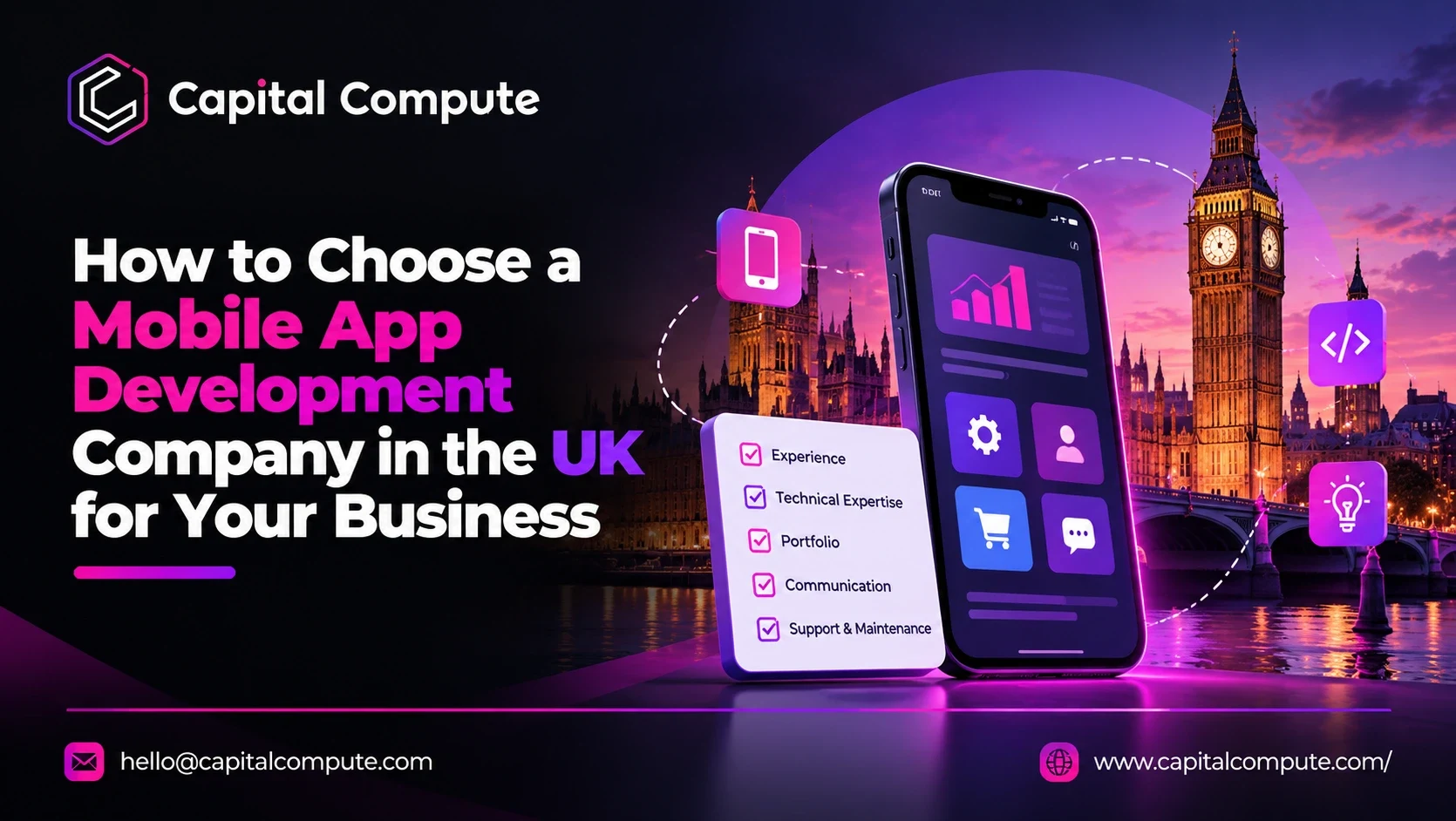
To choose a mobile app development company in the UK, give each shortlisted team the same brief. Ask who will build your app, how they will test the most important user journey and which accounts and assets your business will control. Compare the full cost of building and running the app, including post-launch support.
Ofcom’s Online Nation 2025 report found that UK adult smartphone users used an average of 41 apps in May 2025, up from 36 in May 2023. For your project, start with the task customers or staff need to complete on their phones. Ask each supplier to show how they would build and test it.
Quick Summary
- Define the user problem, the first release and your budget before asking for quotes.
- Ask each supplier to demonstrate a similar workflow, including how it handles an interruption.
- Agree on the platform, code and account ownership, security responsibilities and post-launch support before signing.
For a UK business, the wrong supplier decision can leave you with an app that looks finished but cannot support daily operations. A booking flow may fail when a payment is interrupted. A field-work app may lose records without a signal. A launch can stall because nobody owns store submission.
Use the checks below to compare mobile app development services in the UK and identify the decisions that belong in your scope and contract.
What Should You Check in a Mobile App Development Company in the UK?
Ask each shortlisted company what evidence it can provide, who will own the work and how your organisation will check that each important requirement has been met.
A mobile app development company designs, builds or maintains software for mobile devices. The phrase alone does not tell you which stages it owns. A company that delivers interfaces may still expect your team to provide APIs, cloud hosting, analytics or production support.
| Selection criterion | Evidence to request |
|---|---|
| Product understanding | A written user problem, first-release scope and exclusions |
| Delivery team | Named roles, availability and subcontracting arrangements |
| Platform fit | A rationale tied to your users and required device features |
| Cost control | An itemised quote with assumptions and change-control terms |
| Quality | A test plan linked to important user journeys |
| Ownership | Repository, account, licence and handover arrangements |
| Support | Incident handling, defect policy and maintenance scope |
How Can a Mobile App Development Company in the UK Prove Delivery Quality?
A working demonstration and a delivery record are more useful than a portfolio screenshot. Ask what the supplier built, which constraints it faced and what the client could do after launch. Check the difference between a prototype, a released app and an actively maintained product.
- Can the team demonstrate the relevant workflow and explain the implementation?
- Who owned the backend, testing and release?
- Can a client reference discuss communication, scope changes and support?
For example, ask a supplier for a demonstration of interrupted checkout if your app takes payments. If the app captures field records, ask what happens when the connection drops and returns. The demonstration should expose decisions, not simply show a successful path.
What Should Mobile App Development Services in the UK Include?
A complete engagement should cover discovery, design, implementation, integrations, testing, release and support. Ask for a named owner and a deliverable for each handoff.
Define One First Release That Users Can Complete
Write down who uses the app, the problem it solves and the smallest journey that produces a useful result. An MVP is a bounded first version that tests a product assumption. Include security and recovery behaviour where they affect that first release.
- User and outcome: Who needs to achieve what, and how will you measure it?
- Must-have journey: Which steps must work from beginning to end?
- Dependencies: Which data, APIs, permissions and approvals are required?
- Exclusions: Which ideas belong in a later version?
Consider an illustrative service-booking app. The first release might let a customer choose an appointment, pay and receive confirmation. A loyalty programme can wait. Payment failure, cancellation rules and staff access still need decisions because they affect the core journey.
Our guide to building an MVP around a clear product assumption helps frame that conversation. For each supplier, request a brief showing what will be delivered, what your organisation must supply and what would trigger a change to the estimate.
Name the Backend and Operating Responsibilities
The mobile interface is only part of many business apps. Authentication, payments, notifications, reporting and existing systems may need separate work. Ask who designs, builds and operates these dependencies, and whether they are included in the quote or treated as a client responsibility.
- Name who will build and maintain each API and data integration.
- Assign someone on your side to approve designs and act on user feedback.
- Document deployment and production access before the release deadline.
A company specialising in mobile application development in the UK should explain how its full stack development services connect mobile interfaces with backend systems, databases and business applications.
Should You Choose iOS, Android or Cross-Platform Development?
Choose the platform from your users, required device capabilities and maintenance model. Native development targets a platform directly, commonly using Swift for iOS or Kotlin for Android. Cross-platform frameworks such as React Native or Flutter can share parts of an implementation across platforms, but still require platform-specific testing.
| Approach | Decision to test |
|---|---|
| Native iOS | Do Apple-specific capabilities or target-user devices justify a dedicated implementation? |
| Native Android | Do Android hardware, device-management or workflow needs drive the requirements? |
| Cross-platform | Can shared implementation meet both platforms' user experience and technical needs? |
Shared code can reduce duplicated implementation. Permissions, notifications, payments, store rules and device behaviour can still require platform-specific work. Ask for these differences to be costed before you compare estimates.
A reliable mobile app development company in the UK should explain whether React Native app development, Flutter app development or native development is more appropriate for your product’s requirements.
What Should an iOS App Development Company in the UK Demonstrate?
An iOS app development company in the UK should explain its approach to supported Apple devices, interface behaviour, accessibility and App Store submission. Request evidence of the capabilities your product needs, and a plan for testing both ordinary use and failure states before submission.
Apple’s App Review guidance requires apps that support account creation to let users initiate account deletion within the app. Ask who will implement the flow and test how it handles associated data.
- Which devices and operating-system versions will be supported?
- Who prepares review access, privacy information and submission materials?
- Who resolves review feedback, and what is included in the release scope?
Review our iOS app development services and ask the proposed team how it would test the Apple-specific capabilities your app needs.
When shortlisting an iOS app development company in the UK, review its experience with native application architecture, Apple device integrations and long-term operating-system compatibility. Our guide to choosing an iOS app development company in the UK provides additional information about costs, benefits and hiring considerations.
What Should an Android App Development Agency in the UK Demonstrate?
An Android app development agency in the UK should show how it tests across the devices and screen sizes your users need. Ask about permissions, interrupted connections, background behaviour and monitoring after release. A test plan should name the supported environment and important user journeys.
Google’s core Android app quality guidelines cover basic user experience and technical quality checks. Use them alongside acceptance criteria for your own workflows.
- How will the app behave after sleep, app switching or a network interruption?
- Which supported devices will receive hands-on testing?
- Who monitors crashes and investigates problems after a release?
Our Android app development services describe the service area. If both platforms are required, ask a potential partner to justify native versus shared implementation in writing, with the impact on maintenance and testing included.
How Should You Compare App Development Costs and Timelines?
Compare quotes against the same scope and acceptance criteria. Ask for an estimate in pounds that states VAT treatment, exclusions and third-party costs. Check whether it includes backend work, release testing and support.
Separate Build Costs From Costs of Operating the App
A useful budget distinguishes one-off work from recurring obligations. Request line items for discovery, design, mobile implementation, backend work, testing and launch. Then ask about hosting, paid services, monitoring and maintenance so your organisation can assess the cost after the first release.
- What assumptions would invalidate the estimate?
- What is the agreed process for approving and pricing scope changes?
- Which licences, cloud services or external provider charges are excluded?
- What support is included, and when does a separate maintenance agreement begin?
There is no defensible single price for every business app. The existing UK mobile app development cost guide can provide additional planning context, but ask for a project-specific breakdown before treating a figure as a procurement budget.
Use Milestones With Acceptance Evidence
A timeline should show discovery, design, implementation, testing, acceptance and submission as separate stages. Ask what must be true before each stage can start, who approves it and what evidence closes it. Add dependency dates for integrations and decisions your organisation owns.
- Discovery closes with an agreed scope and unresolved-risk list.
- Design closes with reviewed core journeys and decisions on edge cases.
- Build closes with demonstrable features and the agreed test evidence.
- Launch closes with release responsibilities and a support handover.
App Store or Google Play review is an external dependency. Separate readiness to submit from approval to distribute, and ask how review feedback is handled. A supplier can commit to its own work; it should not promise control over an external review decision.
How Do You Evaluate Security, Ownership and UK Delivery?
Evaluate data flows, access, ownership and working arrangements before implementation. Ask where the team is based, who can access your data and where the app and its services will be hosted.
Plan Privacy Decisions Before They Become Rework
The ICO’s guidance on data protection by design and by default covers planning and the lifecycle of personal data processing. Ask the supplier to document what information the app needs, why it needs it and how access and retention will work. Involve your privacy adviser for project-specific obligations.
- Map user data, third-party SDKs, analytics and administrative access.
- Confirm hosting regions and who can access data remotely.
- Agree authentication, permission handling, deletion and incident responsibilities.
For a product involving sensitive information or children, involve the appropriate specialist during discovery. Ask the team what evidence it can provide for your organisation’s review.
Own the Product Assets as Well as the Source Code
Repository access alone does not make a handover practical. Confirm developer-account control, cloud administration, build instructions, documentation, signing arrangements and third-party licences. Agree how another team would take over, including the release and support systems that sit outside the codebase.
- Record ownership and access arrangements for every product account.
- Require build and deployment instructions that another engineer can follow.
- Name what happens to access, unfinished work and support at contract end.
Record responsibilities in the contract and test whether another engineer can follow the handover documentation. Our UK custom software development services cover work on backends and business systems as well as user interfaces.
Check How the Team Will Work With Your Organisation
Ask which engineers will deliver the work, where they are based and which hours overlap with your team. Confirm who can approve a change or resolve an issue affecting release.
- Agree meeting overlap, escalation routes and the decision-maker for each side.
- Check whether subcontractors are involved and how responsibilities are maintained.
- Agree how often the team will demonstrate working features.
Businesses looking to hire mobile app developers should evaluate technical experience alongside communication practices, engineering availability and accountability throughout the development lifecycle.
How Can AI-Assisted Delivery Improve App Development Responsibly?
Ask the supplier to name where AI is used, what project context it receives and how outputs are reviewed. AI-assisted engineering can support implementation, review and documentation, but your supplier should still explain the human acceptance process and the controls around client code and data.
At Capital Compute, our engineers use project-specific Markdown rules, cross-model pull request review and documentation that records decisions for the next person maintaining the product. Engineers remain responsible for accepting changes.
- Request an example of how architecture rules guide an implementation decision.
- Ask who accepts a proposed change after automated review.
- Confirm provider access, retention and approval controls for code or data before use.
What Does a Useful Delivery Case Study Tell You?
A case study should explain the problem, the supplier’s role and the result it measured. Our Boom screen recorder case study describes a desktop product built with Electron for Windows, macOS and Linux.
For a mobile project, ask for comparable evidence on the platform and user journey that carry the most risk. Have the proposed team walk through what it built and how it tested the release.
How Can Capital Compute Help With Your Mobile App Project?
Capital Compute’s in-house engineers are based in Ahmedabad, India, and work with UK businesses on mobile app development. We help teams scope the first release, choose a platform, connect their systems and plan testing, store submission and support.
- Native iOS and Android development, plus cross-platform delivery with Flutter or React Native.
- Project source code ownership from day one, subject to third-party licence terms.
- Outcome-based billing for agreed sprint deliverables.
- A one-week free trial sprint on an agreed backlog item.
- 90 days of post-launch support, with fixes for defects in our delivered code covered at no development charge.
Request a project estimate with your first-release brief. Once we agree the scope, we can provide a fixed-price estimate within two business days.