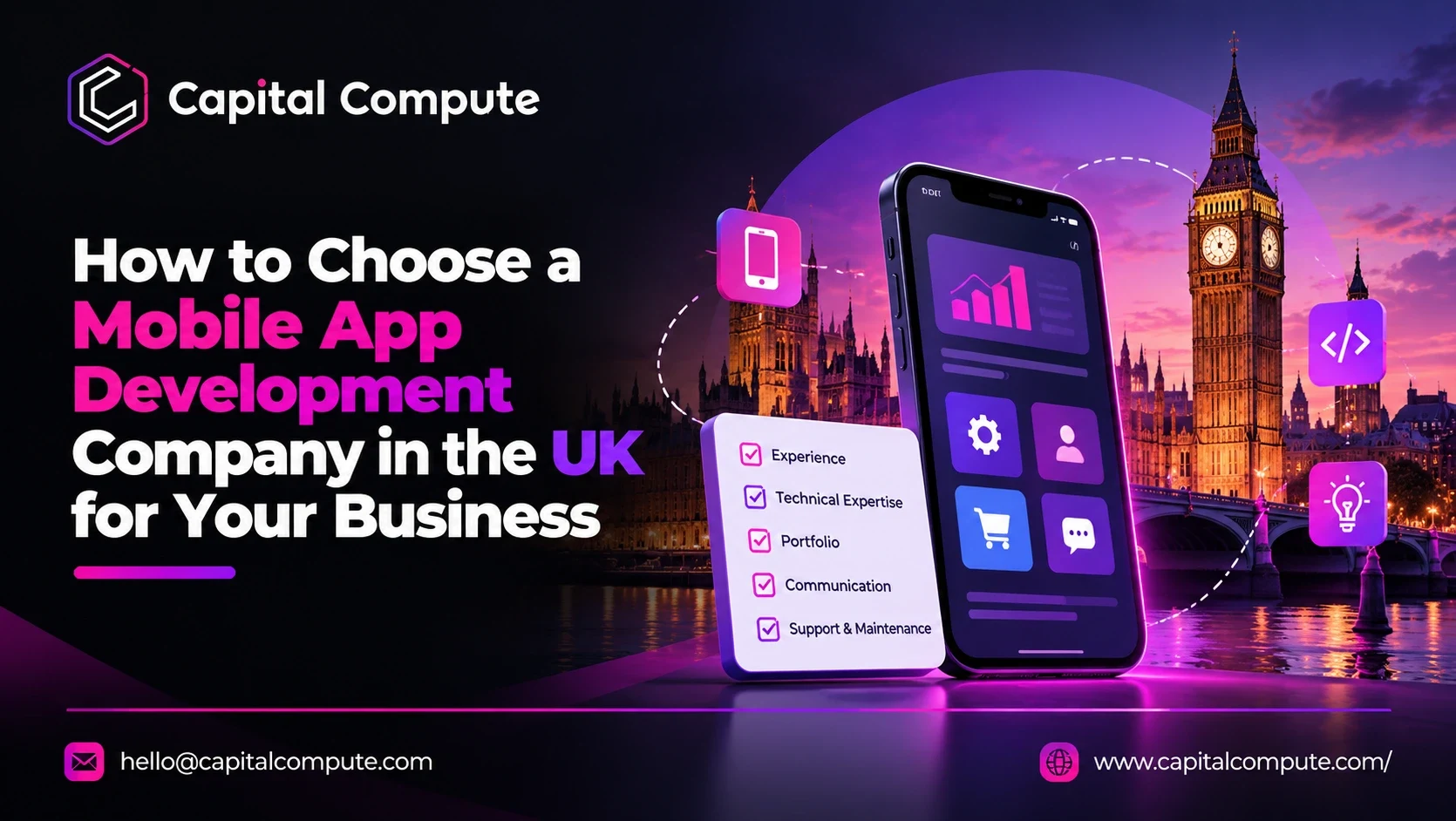
To choose the right mobile app development company in the UK, evaluate its technical expertise, relevant project experience, development process, pricing transparency, security practices and post-launch support. Look for a team that understands your business goals, recommends the right platform—iOS, Android or cross-platform—provides a clear project roadmap, and ensures you retain ownership of your app’s source code and assets. Before making a decision, compare proposals, review relevant case studies, and confirm how the company will manage testing, maintenance and future updates.
Quick Summary
Choose a mobile app development company in UK by checking the team that will build your app, relevant delivery evidence, platform fit, itemised scope, testing, code ownership and post-launch support. Compare providers against the same brief, then resolve gaps in responsibilities and acceptance criteria before committing to the full build.
- Define the user problem and the first release before asking for quotes.
- Request evidence of a similar workflow, not just attractive portfolio screens.
- Confirm who owns the code, developer accounts and infrastructure from the start.
For a UK business, the wrong supplier decision can leave you with an app that looks finished but cannot support daily operations. A booking flow may fail when a payment is interrupted. A field-work app may lose records without a signal. A launch can stall because nobody owns store submission.
The useful comparison is therefore about delivery responsibility. This guide gives you a practical way to compare mobile app development services in UK, test platform recommendations and identify the questions that belong in your scope and contract. Start with the evidence you need, rather than a list of agency claims.
What Should You Check in a Mobile App Development Company in UK?
Ask each shortlisted company to provide three things for every important requirement: evidence, a named owner and an acceptance test. Evidence shows what it has done; an owner establishes responsibility; an acceptance test tells you how your organisation will decide that the work is complete.
A mobile app development company designs, builds or maintains software for mobile devices. The phrase alone does not tell you which stages it owns. A company that delivers interfaces may still expect your team to provide APIs, cloud hosting, analytics or production support.
| Selection criterion | Evidence to request |
|---|---|
| Product understanding | A written user problem, first-release scope and exclusions |
| Delivery team | Named roles, availability and subcontracting arrangements |
| Platform fit | A rationale tied to your users and required device features |
| Cost control | An itemised quote with assumptions and change-control terms |
| Quality | A test plan linked to important user journeys |
| Ownership | Repository, account, licence and handover arrangements |
| Support | Incident handling, defect policy and maintenance scope |
How Can a Mobile App Development Company in UK Prove Delivery Quality?
A working demonstration and a delivery record are more useful than a portfolio screenshot. Ask what the supplier built, which constraints it faced and what the client could do after launch. Check the difference between a prototype, a released app and an actively maintained product.
- Can the team demonstrate the relevant workflow and explain the implementation?
- Who owned the backend, testing and release, rather than only the visible screens?
- Can a client reference discuss communication, scope changes and support?
For example, ask a supplier for a demonstration of interrupted checkout if your app takes payments. If the app captures field records, ask what happens when the connection drops and returns. The demonstration should expose decisions, not simply show a successful path.
What Should Mobile App Development Services in UK Include?
A complete engagement should define discovery, design, implementation, integrations, testing, release and support. These activities may be delivered by different people, but every handoff needs an owner. Review the scope as a sequence of outputs rather than a collection of technical skills.
Define One First Release That Users Can Complete
Write down who uses the app, the problem it solves and the smallest journey that produces a useful result. An MVP is a bounded first version intended to test a product assumption with users. It is not permission to leave important security or recovery behaviour undefined.
- User and outcome: who needs to achieve what, and how will you measure it?
- Must-have journey: which steps must work from beginning to end?
- Dependencies: which data, APIs, permissions and approvals are required?
- Exclusions: which ideas belong in a later version?
Consider an illustrative service-booking app. The first release might let a customer choose an appointment, pay and receive confirmation. A loyalty programme can wait. Payment failure, cancellation rules and staff access still need decisions because they affect the core journey.
Our guide to building an MVP around a clear product assumption helps frame that conversation. For each supplier, request a brief showing what will be delivered, what your organisation must supply and what would trigger a change to the estimate.
Name the Backend and Operating Responsibilities
The mobile interface is only part of many business apps. Authentication, payments, notifications, reporting and existing systems may need separate work. Ask who designs, builds and operates these dependencies, and whether they are included in the quote or treated as a client responsibility.
- API and data responsibilities should be named rather than left as an integration assumption.
- Design approvals and user feedback should have a decision-maker on your side.
- Deployment and production access should be documented before the release deadline.
Should You Choose iOS, Android or Cross-Platform Development?
Choose the platform from your users, required device capabilities and maintenance model. Native development targets a platform directly, commonly using Swift for iOS or Kotlin for Android. Cross-platform frameworks such as React Native or Flutter can share parts of an implementation across platforms, but still require platform-specific testing.
| Approach | Decision to test |
|---|---|
| Native iOS | Do Apple-specific capabilities or target-user devices justify a dedicated implementation? |
| Native Android | Do Android hardware, device-management or workflow needs drive the requirements? |
| Cross-platform | Can shared implementation meet both platforms' user experience and technical needs? |
A shared codebase is not a guarantee that every feature takes half the effort. Permissions, notifications, payments, store rules and device behaviour may differ. Ask the supplier to identify those differences before comparing estimates, and to show where shared code ends and platform-specific work begins.
What Should an iOS App Development Company in UK Demonstrate?
An iOS app development company in UK should explain its approach to supported Apple devices, interface behaviour, accessibility and App Store submission. Request evidence of the capabilities your product needs, and a plan for testing both ordinary use and failure states before submission.
Apple states that apps supporting account creation must allow users to initiate account deletion within the app. A supplier should identify requirements like this during design, not discover them when the release is ready. Ask who implements the flow and who checks its handling of associated data.
- Which devices and operating-system versions will be supported?
- Who prepares review access, privacy information and submission materials?
- Who resolves review feedback, and what is included in the release scope?
Explore our iOS app development services for the relevant service context. Evaluate the delivery evidence alongside the page: a technology list is a starting point for questions, not a substitute for answers about your product.
What Should an Android App Development Agency in UK Demonstrate?
An Android app development agency in UK should show how it tests across the devices and screen sizes your users need. Ask about permissions, interrupted connections, background behaviour and monitoring after release. A test plan should name the supported environment and important user journeys.
Google’s core Android app quality guidelines cover fundamental user experience and technical quality checks. Use them as a discussion prompt when reviewing a proposed test plan. Your business-specific acceptance criteria still need to be added; platform guidance does not define a successful business workflow for you.
- How will the app behave after sleep, app switching or a network interruption?
- Which supported devices will receive hands-on testing?
- Who monitors crashes and investigates problems after a release?
Our Android app development services describe the service area. If both platforms are required, ask a potential partner to justify native versus shared implementation in writing, with the impact on maintenance and testing included.
How Should You Compare App Development Costs and Timelines?
Compare prices only after aligning scope, deliverables, assumptions and responsibilities. Ask for an estimate in pounds that states VAT treatment, exclusions and third-party costs. A lower quote can reflect less testing, no backend work or a smaller support commitment rather than a more efficient delivery plan.
Separate Build Costs From Costs of Operating the App
A useful budget distinguishes one-off work from recurring obligations. Request line items for discovery, design, mobile implementation, backend work, testing and launch. Then ask about hosting, paid services, monitoring and maintenance so your organisation can assess the cost after the first release.
- What assumptions would invalidate the estimate?
- What is the agreed process for approving and pricing scope changes?
- Which licences, cloud services or external provider charges are excluded?
- What support is included, and when does a separate maintenance agreement begin?
There is no defensible single price for every business app. The existing UK mobile app development cost guide can provide additional planning context, but ask for a project-specific breakdown before treating a figure as a procurement budget.
Use Milestones With Acceptance Evidence
A timeline should show discovery, design, implementation, testing, acceptance and submission as separate stages. Ask what must be true before each stage can start, who approves it and what evidence closes it. Add dependency dates for integrations and decisions your organisation owns.
- Discovery closes with an agreed scope and unresolved-risk list.
- Design closes with reviewed core journeys and decisions on edge cases.
- Build closes with demonstrable features and the agreed test evidence.
- Launch closes with release responsibilities and a support handover.
App Store or Google Play review is an external dependency. Separate readiness to submit from approval to distribute, and ask how review feedback is handled. A supplier can commit to its own work; it should not promise control over an external review decision.
How Do You Evaluate Security, Ownership and UK Delivery?
Evaluate the data flow, access model, contractual responsibilities and working arrangements before implementation. UK targeting is not evidence of UK incorporation, a UK office or UK-hosted infrastructure. Ask for factual answers about who delivers the work and where data can be accessed.
Plan Privacy Decisions Before They Become Rework
The ICO explains that data protection by design and by default starts during planning and continues throughout the lifecycle. Ask your supplier to document the information the app needs, why it needs it and how access and retention will work. Involve your privacy adviser for project-specific obligations.
- Map user data, third-party SDKs, analytics and administrative access.
- Confirm hosting regions and remote access, rather than assuming UK or EU hosting.
- Agree authentication, permission handling, deletion and incident responsibilities.
An app agency’s assurance does not replace your organisation’s own review. For a product involving sensitive information or children, bring the appropriate specialist into discovery. Ask what evidence the delivery team can supply rather than relying on a blanket claim of compliance.
Own the Product Assets as Well as the Source Code
Repository access alone does not make a handover practical. Confirm developer-account control, cloud administration, build instructions, documentation, signing arrangements and third-party licences. Agree how another team would take over, including the release and support systems that sit outside the codebase.
- Record ownership and access arrangements for every product account.
- Require build and deployment instructions that another engineer can follow.
- Name what happens to access, unfinished work and support at contract end.
Treat the contract as a description of responsibilities, not a substitute for technical evidence. If ownership or licence wording is unclear, have the agreement reviewed. Our UK custom software development services provide broader context for an engagement that includes the app’s backend and business systems.
Check How the Team Will Work With Your Organisation
Ask which engineers will deliver the work, where they work and how much overlap you will have with them. A UK-based supplier may use an overseas team, while an overseas partner may support UK clients directly. Compare the actual arrangement, not the wording of a landing page.
- Agree meeting overlap, escalation routes and the decision-maker for each side.
- Check whether subcontractors are involved and how responsibilities are maintained.
- Request a working demonstration cadence, not status reports alone.
How Can AI-Assisted Delivery Improve App Development Responsibly?
Ask the supplier to name where AI is used, what project context it receives and how outputs are reviewed. AI-assisted engineering can support implementation, review and documentation, but your supplier should still explain the human acceptance process and the controls around client code and data.
At Capital Compute, our proprietary workflow uses technology- and domain-specific markdown rule files, cross-model pull-request review and automatic documentation with knowledge capture. The intent is to reduce avoidable rework while preserving context for the engineers who maintain the product. We do not treat tool use as proof of a particular speed increase.
- Request an example of how architecture rules guide an implementation decision.
- Ask who accepts a proposed change after automated review.
- Confirm provider access, retention and approval controls for code or data before use.
Capital Compute delivers through internal engineers without subcontracting, with code ownership from day one. We offer outcome-based billing for agreed sprint outputs and a one-week free trial sprint on a real backlog. Defects in our own code are fixed at no development charge, with 90 days of post-launch support.
Those arrangements give you concrete questions to test during a selection process. Explore our mobile app development services and request a project estimate. A fixed-price estimate is available in two business days once the scope is agreed; the free trial sprint provides a bounded way to evaluate collaboration.
What Does a Useful Delivery Case Study Tell You?
A case study should explain the problem, implementation and observable result, with the supplier’s role clear. Capital Compute’s Boom screen recorder case study describes an Electron desktop product across Windows, macOS and Linux, with an average journey from opening to sharing of under one minute.
That is a product-engineering example, not evidence of native iOS or Android delivery, a UK sector result or an AI-workflow speed claim. For your mobile project, request comparable evidence covering the platform, integrations and user journey that carry the most risk.
How Do You Select a Mobile App Development Company in UK?
Use the same brief for your shortlist, resolve the risks that could stop delivery and then compare the remaining trade-offs. Do not let a strong average score conceal an unresolved ownership issue or a missing integration responsibility. A bounded discovery engagement or trial can test the working relationship.
- Share one brief, including users, outcomes, scope and constraints.
- Request the same evidence, owners and acceptance criteria from each supplier.
- Check references and demonstrate the highest-risk workflow.
- Resolve scope, data, ownership and support terms before signing.
- Start with a bounded deliverable and review the evidence before expanding.
The right mobile app development company in UK is the team that can explain how your product will be built, accepted and maintained. Bring your first-release brief to request a project estimate. Start with a scoped conversation and use the one-week free trial sprint to evaluate how our engineers work with your team.