Offshore software development costs often look attractive at the beginning. A lower hourly rate, access to global developers, and faster hiring can make offshore development seem like the easiest way to reduce project expenses.
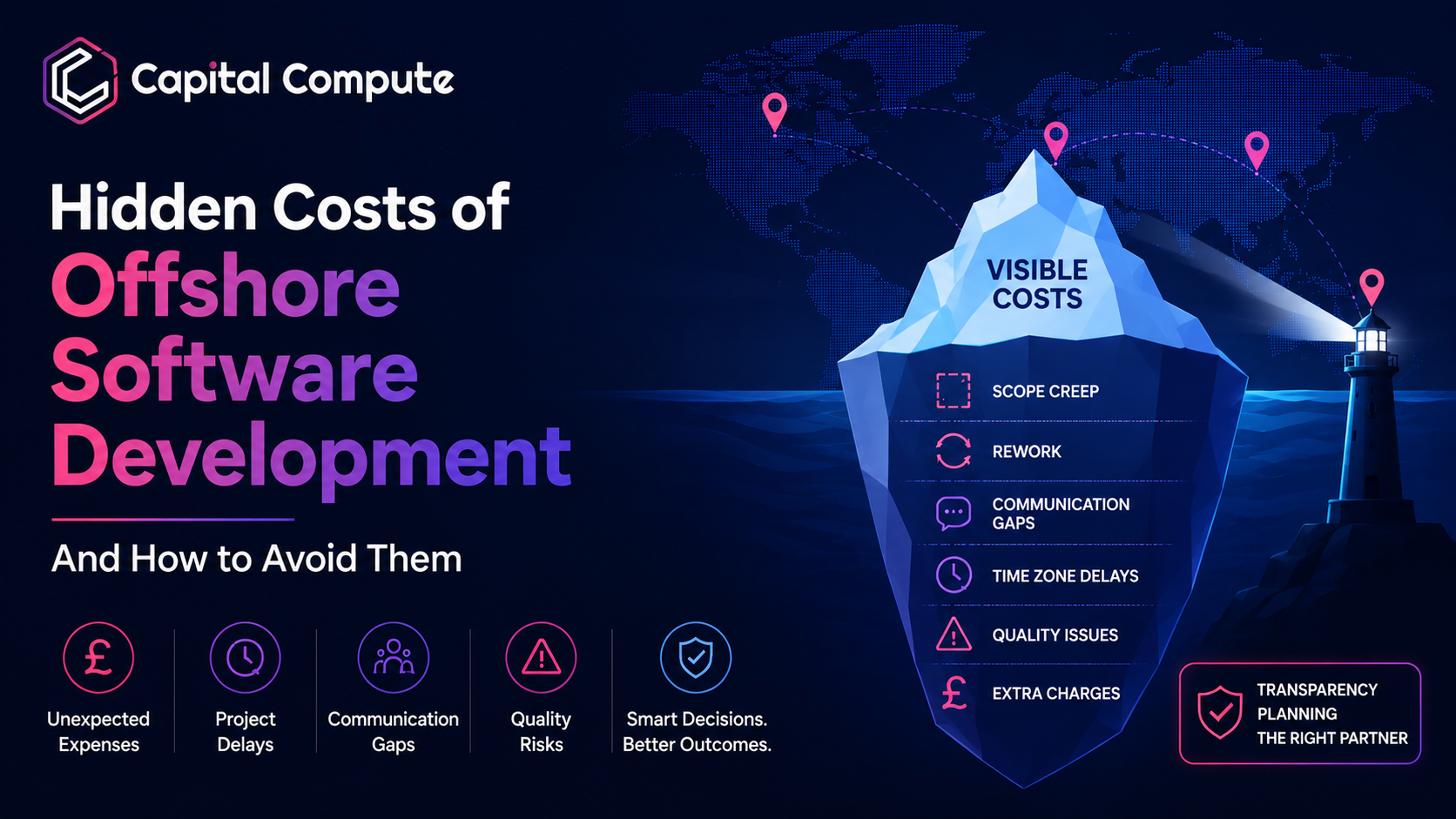
However, the real cost of offshore software development is not only the developer’s hourly rate. Many businesses later discover hidden expenses in communication, project management, rework, onboarding, quality control, security, and long-term maintenance.
For startups, SaaS companies, and growing businesses, these hidden costs can delay product launches, increase development budgets, and create technical problems that become expensive to fix later.
In this guide, we will explain the major hidden costs of offshore software development and how to avoid them before they affect your project.
What Are Offshore Software Development Costs?
Offshore software development refers to the total amount a business spends when hiring a development team from another country to build software, web applications, mobile apps, SaaS platforms, or digital products.
- These costs usually include:
- Developer hourly rates
- Project management fees
- UI/UX design costs
- Quality assurance and testing
- Communication and coordination time
- Cloud hosting and infrastructure
- Security and compliance work
- Maintenance and future updates
The problem is that many businesses only compare hourly rates. For example, if one offshore developer charges less than a local developer, the project may appear cheaper. But if the offshore team requires more management, creates more rework, or delays delivery, the final cost can become much higher than expected.
Why Offshore Development Looks Cheaper at First
Offshore development is popular because it offers access to developers in countries where labour costs are lower. This can be useful for businesses that need to scale quickly or build software without hiring a full in-house team.
The initial benefits often include:
- Lower hourly development rates
- Access to a larger talent pool
- Faster team setup
- Flexible hiring models
- Reduced recruitment effort
But lower hourly pricing does not always mean lower total project cost. Software development depends on clarity, communication, planning, architecture, testing, and long-term maintainability. If these areas are weak, hidden costs start increasing.
1. Communication Delays
One of the most common hidden costs of offshore software development is communication delay.
When your team and offshore developers work in different time zones, simple questions can take hours or even a full day to resolve. A small clarification about a feature, design change, or API requirement can delay the next step of development.
For example, if a developer misunderstands a requirement and builds the wrong functionality, your business pays for the original work, the review time, the correction, and the retesting.
How to avoid this cost
Create clear communication rules before the project starts. Define:
- Daily meeting time
- Preferred communication tools
- Response time expectations
- Project manager responsibilities
- Documentation process
- Approval workflow
A good full stack development team should not only write code. They should also communicate clearly, ask the right questions, and keep the project moving without confusion.
2. Poor Requirement Documentation
Many offshore software projects become expensive because the requirements are not clear from the beginning.
If the development team does not fully understand the business logic, user roles, workflows, integrations, and expected outcomes, they may build features that do not match your actual needs.
This leads to scope changes, repeated revisions, and budget increases.
How to avoid this cost
Before development starts, prepare a clear project scope that includes:
- Business goals
- User journeys
- Feature list
- Technical requirements
- Admin panel requirements
- Third-party integrations
- Security needs
- Future scaling expectations
For custom software development, documentation is not optional. It protects your budget and helps the development team build the right solution from the start.
3. Rework and Bug Fixing
Rework is one of the biggest hidden offshore development costs. It happens when a feature is built incorrectly, does not match the design, fails during testing, or does not support the required business process.
Rework can happen because of:
- Miscommunication
- Weak technical planning
- Poor code quality
- Lack of testing
- Unclear acceptance criteria
- Inexperienced developers
At first, rework may look like a small delay. But when it happens repeatedly, it increases development hours, testing time, and project management effort.
How to avoid this cost
Use milestone-based development. Each feature should be reviewed and approved before moving to the next stage.
Also, ask your development partner to follow:
- Code reviews
- QA testing
- Sprint demos
- Version control
- Clear acceptance criteria
- Proper staging environment
A reliable software development team should focus on building clean, scalable, and maintainable code, not just completing tasks quickly.
4. Hidden Project Management Costs
Many businesses forget that offshore teams often need more management than expected.
Even if developers are affordable, someone still needs to manage:
- Daily task allocation
- Sprint planning
- Code reviews
- Testing feedback
- Timeline tracking
- Requirement clarification
- Client communication
If your internal team spends too much time managing the offshore team, your actual cost increases.
How to avoid this cost
Choose a development partner that provides strong project management along with engineering. This is especially important for custom software development and full stack development projects where frontend, backend, database, APIs, and deployment must work together smoothly.
A strong project manager can reduce confusion, prevent delays, and keep the project aligned with your business goals.
5. Quality Control and Testing Costs
Low-cost offshore development can become expensive when testing is treated as an afterthought.
Without proper QA, your software may have:
- Broken features
- Poor mobile responsiveness
- Slow page speed
- Security issues
- Integration failures
- Poor user experience
- Performance problems
Fixing these issues after launch is usually more expensive than preventing them during development.
How to avoid this cost
Include testing in the project budget from the beginning.
Your QA process should include:
- Functional testing
- UI testing
- Mobile responsiveness testing
- Browser compatibility testing
- API testing
- Security testing
- Performance testing
For business-critical software, testing should not be skipped to save money. Good testing reduces long-term software development costs.
6. Security and Compliance Risks
Security is another hidden cost that businesses often ignore during offshore development.
If your software stores customer data, payment information, business records, or confidential documents, poor security can create serious financial and legal risks.
Security costs may include:
- Secure authentication
- Role-based access
- Data encryption
- Secure API development
- Backup systems
- Compliance updates
- Vulnerability fixing
How to avoid this cost
Discuss security requirements before development starts. Ask your software development partner how they handle:
- User authentication
- Database security
- API protection
- Access control
- Code security
- Cloud infrastructure
- Data backup
Security should be part of the architecture, not something added after launch.
7. Technical Debt
Technical debt happens when software is built quickly without proper structure, clean code, documentation, or scalable architecture.
At first, the product may work. But later, it becomes difficult to update, maintain, or scale.
Technical debt can create problems such as:
- Slow development of new features
- Frequent bugs
- Poor performance
- Expensive maintenance
- Difficult onboarding for new developers
- Complete redevelopment in the future
How to avoid this cost
Work with a team that understands long-term software architecture. For full stack development, the frontend, backend, database, APIs, and cloud setup should be planned together.
A good development partner will write code that is clean, readable, scalable, and easy to maintain.
8. Infrastructure and Hosting Costs
Many businesses plan the development cost but forget about infrastructure costs.
After launch, your software may need:
- Cloud hosting
- Database hosting
- File storage
- CDN setup
- Email services
- Monitoring tools
- Backup systems
- Server maintenance
If your application grows, these costs can increase.
How to avoid this cost
Ask for an infrastructure estimate before development starts. Your team should recommend a cloud setup based on your expected users, traffic, data storage, and scaling needs.
This helps you understand the complete offshore software development cost, not just the coding cost.
9. Vendor Lock-In
Vendor lock-in happens when your business becomes too dependent on one offshore team because they control the code, documentation, deployment, or technical knowledge.
This can become expensive if:
- You want to change vendors
- The team becomes unavailable
- Support quality drops
- Documentation is missing
- Code is difficult to understand
How to avoid this cost
Make sure you own:
- Source code
- Design files
- Documentation
- Hosting access
- Database access
- Deployment process
- API credentials
Your software should be built in a way that another qualified team can understand and maintain if needed.
10. Staff Turnover and Attrition
Staff turnover is another hidden cost in offshore software development. If developers leave during the project, your business may face delays, knowledge gaps, and extra onboarding costs for replacement developers.
This can affect:
- Development speed
- Code quality
- Product knowledge
- Delivery timelines
- Project consistency
When the same developers do not stay throughout the project, your internal team may need to explain the same requirements again and again.
How to avoid this cost
Ask your offshore partner how they manage developer replacement, documentation, and knowledge transfer.
Make sure the project has:
- Updated technical documentation
- Code comments where needed
- Shared project access
- Regular handover notes
- Backup developers or team support
This reduces dependency on one developer and protects the project from sudden delays.
How to Reduce Offshore Software Development Costs
The best way to reduce offshore software development costs is not to choose the cheapest team. The best way is to choose the right team and plan the project properly.
Here are practical steps:
- Start with a clear project scope
- Build an MVP first
- Prioritize core features
- Use milestone-based delivery
- Set communication rules
- Include QA from the beginning
- Plan scalable architecture
- Keep documentation updated
- Review code regularly
- Track total project cost, not only hourly rates
A well-managed offshore project can still be cost-effective. But it requires transparency, strong engineering, and clear ownership.
Why Choose Capital Compute for Custom Software Development?
Capital Compute helps businesses build scalable web applications, mobile apps, SaaS products, and full stack digital solutions with a strong focus on clean engineering and long-term performance.
Our services include:
- Custom Software Development
- Full Stack Development
- MVP Engineering
- Web App Engineering
- Mobile App Engineering
- Custom SaaS Product Development
- Architecture Review
- Resource Augmentation
We help businesses avoid hidden software development costs by focusing on clear planning, scalable architecture, readable code, and reliable delivery.
If you are planning to build a software product, SaaS platform, business application, or full stack web solution, Capital Compute can help you plan the right approach before development begins.
Final Thoughts
Offshore software development costs can be lower than hiring locally, but only when the project is managed correctly. The cheapest hourly rate does not always deliver the best value.
Hidden costs such as communication delays, rework, poor testing, technical debt, security issues, and vendor lock-in can increase the final budget and affect product quality.
To avoid these risks, businesses should focus on clear planning, strong project management, scalable architecture, and experienced full stack development support.
Ready to Build Software Without Hidden Costs?
Capital Compute helps businesses plan, build, and scale custom software solutions with clean code, strong architecture, and transparent development practices.
Contact Capital Compute today to discuss your custom software development or full stack development project.