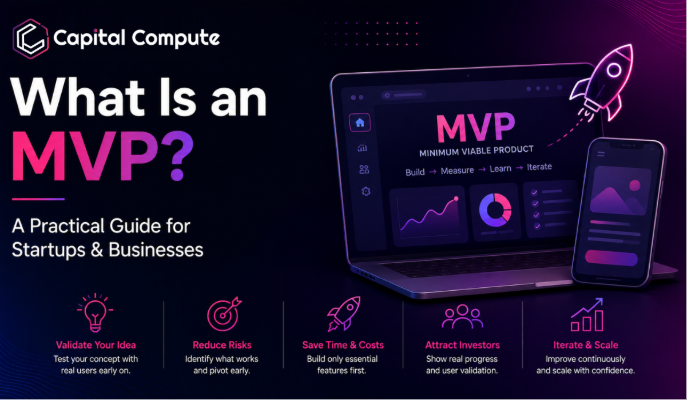
If you are planning to launch a new digital product, one of the first questions you may ask is: what is MVP in software development?
An MVP, or Minimum Viable Product, is the simplest functional version of a software product that includes only the core features needed to test an idea with real users. Instead of spending months or years building a full product based on assumptions, an MVP helps businesses validate demand, collect feedback, reduce risk, and make smarter development decisions.
For startups, founders, and growing businesses, MVP development is not just about building something quickly. It is about building the right thing first.
A well-planned MVP can help you test your product idea, understand your users, attract investors, and decide whether your software should be improved, changed, or scaled. However, the success of an MVP depends heavily on the team building it. That is why understanding the criteria for selecting a reliable software development partner for MVP projects is just as important as understanding the MVP itself.
In this guide, we will explain what an MVP means in software development, why it matters, what features it should include, common mistakes to avoid, and how to choose the right software development partner to build one.
What Is MVP in Software Development?
An MVP in software development is a working version of a software product that includes the minimum set of features required to solve a specific user problem.
The goal of an MVP is not to launch a perfect product. The goal is to launch a usable product that helps you learn from real users.
A strong MVP should answer important questions such as:
- Do users actually need this solution?
- Are users willing to use the product?
- Which features matter most?
- Is the business idea technically possible?
- Is the product worth further investment?
- What should be improved before scaling?
For example, if you want to build a SaaS platform for appointment scheduling, your MVP may only include user registration, calendar booking, basic notifications, and admin access. Advanced features like AI recommendations, payment automation, analytics dashboards, and CRM integrations can be added later after the core idea is validated.
This approach helps businesses avoid wasting money on features users may not need.
Why Is an MVP Important in Software Development?
Software development can be expensive, time-consuming, and risky when there is no clear validation. Many businesses make the mistake of building a full product before confirming whether users actually want it.
An MVP reduces this risk by focusing on learning first.
-
It Validates the Business Idea
An MVP helps you test whether your idea solves a real problem. Instead of depending only on market research or internal assumptions, you get feedback from actual users.
This is especially useful for startups that need proof before investing heavily in full-scale development.
-
It Reduces Development Cost
Building a complete software product from the beginning can require a large budget. An MVP allows you to start with essential functionality only.
This helps you control costs while still launching something useful.
-
It Speeds Up Time to Market
An MVP helps you enter the market faster. Instead of waiting until every feature is ready, you can launch the core version, collect feedback, and improve the product step by step.
Speed matters because early market entry can help you understand users before competitors do.
-
It Helps Attract Investors
Investors usually want more than just an idea. They want evidence. A working MVP can show traction, user interest, and product potential.
Even simple usage data can make your pitch stronger.
-
It Creates a Better Final Product
The best software products are shaped by real user behavior. An MVP gives you insights that help your development team improve the product based on facts, not guesses.
What Features Should an MVP Include?
A successful MVP should include only the features required to validate the main product idea.
Before choosing features, ask this question:
“What is the smallest version of this product that can still solve the user’s main problem?”
Core MVP Features Usually Include:
- User registration or login
- Main user workflow
- Basic dashboard
- Essential data input/output
- Admin panel
- Basic notifications
- Simple reporting
- Payment flow, if required
- Feedback collection
- Basic security setup
The exact features depend on your product type. A marketplace MVP, SaaS MVP, mobile app MVP, internal business tool, and AI-powered platform will all have different requirements.
The important point is to avoid overbuilding.
Common Mistakes Businesses Make While Building an MVP
Many MVP projects fail not because the idea is bad, but because the development approach is wrong.
-
Adding Too Many Features
An MVP should be focused. When businesses try to include every possible feature, the project becomes expensive, slow, and confusing.
A feature-heavy MVP can delay validation and increase risk.
-
Ignoring User Feedback
An MVP is designed to learn from users. If you launch it but do not collect feedback, usage data, or behavior insights, you miss the main purpose.
Feedback should guide future development.
-
Choosing the Cheapest Development Team
Cost matters, but the cheapest team is not always the best choice. Poor architecture, weak communication, and low-quality code can create bigger costs later.
A reliable development partner should balance affordability with quality.
-
Skipping Technical Planning
Even though an MVP is simple, it should still be technically strong. Bad architecture can make future scaling difficult.
A good MVP should be lean, but not poorly built.
-
Treating the MVP as the Final Product
An MVP is the beginning of the product journey, not the end. After launch, the product should be improved based on feedback, analytics, and business goals.
How the MVP Development Process Works
A professional software development partner usually follows a structured process to build an MVP.
-
Discovery and Idea Validation
The first step is understanding the product idea, target users, business model, and core problem.
At this stage, the team identifies:
- Target audience
- User pain points
- Product goals
- Competitor gaps
- Core features
- Technical requirements
- Success metrics
Discovery prevents confusion before development begins.
-
Feature Prioritization
Once the idea is clear, the next step is deciding which features are essential.
A good software development partner will separate features into:
- Must-have features
- Should-have features
- Nice-to-have features
- Future features
The MVP should focus mainly on must-have features.
-
UI/UX Design
Design is important because users need to understand the product easily. MVP design should be clean, simple, and user-focused.
The goal is not heavy visual decoration. The goal is usability.
-
Full Stack Development
Full stack development includes both frontend and backend development.
The frontend is what users see and interact with. The backend handles data, APIs, authentication, business logic, and system performance.
For MVPs, full stack development is important because the product must work smoothly from user interface to database.
-
Testing and Quality Assurance
Before launch, the MVP should be tested for bugs, usability issues, performance problems, and security risks.
Even a basic MVP should be stable enough for real users.
-
Launch and Feedback Collection
After launch, the team should collect user feedback and track product usage.
Important MVP metrics may include:
- Number of active users
- Sign-up rate
- Feature usage
- Drop-off points
- Customer feedback
- Conversion rate
- Retention rate
These insights help decide what to build next.
Criteria for Selecting a Reliable Software Development Partner for MVP
Choosing the right development partner can decide whether your MVP succeeds or fails. The right partner will not just write code. They will help you think clearly, reduce risk, and build a scalable foundation.
Here are the most important criteria for selecting a reliable software development partner for MVP projects.
-
Product Thinking, Not Just Coding
A reliable MVP partner should understand product strategy. They should ask questions about users, business goals, market fit, and long-term plans.
If a team starts development without understanding the problem, they may build the wrong solution.
Look for a partner who can help you decide what to build, what to avoid, and what to prioritize.
-
Experience in Custom Software Development
MVPs often require custom workflows, unique user journeys, and business-specific logic. That is why experience in custom software development is important.
A custom software development company can build an MVP around your exact needs instead of forcing your idea into a generic template.
This is especially useful for SaaS platforms, business automation tools, marketplaces, internal dashboards, and web applications.
-
Strong Full Stack Development Skills
Your MVP needs both frontend and backend expertise. A strong full stack development team can manage the complete product lifecycle, including user interface, database, APIs, cloud setup, authentication, and integrations.
This reduces dependency on multiple vendors and improves delivery speed.
-
Clear Communication
Communication is one of the biggest success factors in MVP development.
A reliable partner should provide:
- Clear timelines
- Regular updates
- Transparent pricing
- Simple explanations
- Progress demos
- Fast response times
- Honest feedback
If communication is poor during the sales stage, it may become worse during development.
-
Scalable Architecture
An MVP should be small, but it should not be weak. If the MVP works and users like it, you will need to add more features, users, integrations, and data.
A good development partner will build the MVP with future scaling in mind.
This does not mean overengineering. It means making smart technical decisions from the beginning.
-
Relevant Technology Expertise
The right technology stack depends on the product. Your partner should recommend technologies based on your goals, not just personal preference.
For many modern web and SaaS MVPs, technologies like React, Node.js, TypeScript, cloud hosting, and scalable databases are commonly used.
A reliable partner should explain why a technology is suitable for your product.
-
UI/UX Understanding
Even if your MVP has limited features, users should be able to use it easily. Poor user experience can make a good idea look bad.
Your partner should understand user flows, wireframes, responsive design, and usability testing.
-
Transparent Pricing and Scope
MVP pricing should be clear. You should understand what is included, what is excluded, and what may cost extra later.
- Before starting, ask for:
- Project scope
- Feature list
- Timeline
- Payment structure
- Revision policy
- Support terms
- Ownership rights
Transparency helps avoid conflicts later.
9. Post-Launch Support
The real learning starts after launch. Your development partner should support you after the MVP goes live.
- Post-launch support may include:
- Bug fixing
- Performance monitoring
- User feedback improvements
- Feature updates
- Security updates
- Technical consultation
A partner who disappears after launch is not ideal for MVP success.
10. Ownership and Code Quality
Make sure you own the source code, product data, and intellectual property. Also, ask how the team manages code quality.
Clean code makes future development easier, faster, and more cost-effective.
Why Capital Compute Is a Strong Partner for MVP Development
Capital Compute helps businesses build scalable digital products through custom software development, MVP engineering, full stack development, web app engineering, mobile app engineering, architecture review, and custom SaaS product development.
For businesses planning to build an MVP, Capital Compute brings a practical engineering approach focused on clean code, scalable architecture, thoughtful design, and long-term product success.
Instead of building unnecessary features from day one, Capital Compute can help businesses define the core product idea, prioritize essential features, build the first usable version, and improve it after launch.
This makes Capital Compute a strong choice for startups, founders, and businesses that want to test an idea quickly without compromising future scalability.
Final Thoughts
So, what is MVP in software development?
An MVP is the first functional version of your software product, built with only the essential features needed to test your idea with real users. It helps reduce risk, save cost, validate market demand, and create a smarter path toward full product development.
However, an MVP is only successful when it is planned and built correctly. That is why choosing the right development partner matters.
When reviewing the criteria for selecting a reliable software development partner for MVP projects, look for product thinking, custom software development experience, full stack development expertise, clear communication, scalable architecture, transparent pricing, and post-launch support.
A good MVP is not about building less. It is about building smart.
Ready to Build Your MVP?
Capital Compute helps startups and businesses turn ideas into scalable software products through MVP engineering, custom software development, and full stack development.
If you are planning to build an MVP, get in touch with Capital Compute today and start with the right technical foundation.