Knowing whether your business is ready to develop custom software means identifying the point where off-the-shelf tools cost you more than a purpose-built system would. That cost shows up in wasted time, lost revenue, and missed competitive opportunities. For most UK businesses, that moment arrives well before they act on it and the signs below will tell you exactly which side of the line you are on.
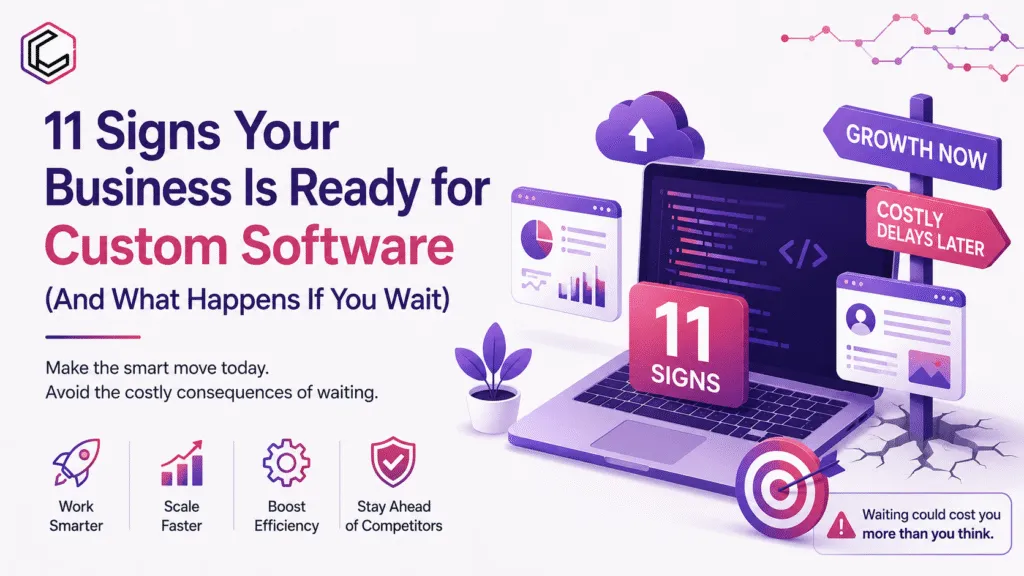
The Short Version: 11 Signs at a Glance
Scanning for a quick read? Here is what each sign points to:
- Your team spends more than 20% of their week on manual data entry or copy-paste workflows
- You have outgrown your SaaS stack but cannot find a single tool that replaces it
- You are stitching together 5+ tools via Zapier or Make and the automations keep breaking
- Your pricing model, workflow, or compliance requirement does not fit any standard software
- You are losing deals because your systems cannot do what competitors’ systems can
- Onboarding a new hire takes weeks because your processes live in spreadsheets and email
- You have paid for integrations that never fully worked
- Your reporting requires manual effort every time a decision gets made
- You operate in a regulated industry where off-the-shelf tools create audit risk
- You are scaling fast enough that manual processes will become a liability within 12 months
- You are spending more on SaaS licences annually than a custom build would cost over three years
Each of these signs carries a compounding cost. The longer you wait, the more embedded the workarounds become and the harder the eventual migration gets.
How AI Has Changed Custom Software Development in 2025
AI has fundamentally altered the economics and speed of custom software development. If you evaluated a build two or three years ago and ruled it out on cost or timeline grounds, those numbers no longer apply.
The Old Cost Barrier Has Gone
Until recently, a mid-complexity custom system for a UK SME required a team of three to five developers and a minimum of six months before anything reached production. The cost floor sat high enough that many businesses with genuine needs could not justify it. That has changed and the shift is not marginal.
What AI Tooling Does to Delivery Timelines
AI-assisted development tools compress delivery timelines by 40–60% on average. Cursor, GitHub Copilot, and Codex directed by experienced developers accelerate the code-writing phase dramatically. Requirements analysis, API integration scaffolding, and test coverage that previously took weeks now complete in days. Lower quality is not the trade-off. Faster delivery at lower cost, without sacrificing the architecture decisions that determine whether a system scales that is the actual outcome.
Three Practical Implications for Buyers
First, the minimum viable build now sits at price points that make commercial sense for businesses with 15–50 employees, not just enterprises. Second, iteration cycles are shorter the gap between your feedback and working software has narrowed from weeks to days. Third, AI handles the repetitive, low-value development work, so your budget goes toward architecture and logic rather than boilerplate.
What AI Inside the Software Makes Possible
Systems built today embed intelligent automation as standard. Automated document parsing, AI-assisted data categorisation, natural language reporting, and anomaly detection capabilities that previously required a separate data science engagement now sit within reach at standard development price points. Any business that generates documents or processes data at volume can access these features as part of a standard custom build.
The barrier to custom software has dropped significantly over the last 24 months. Any business that dismissed a build as too expensive or too slow in 2022 should re-evaluate with 2025 benchmarks.
The 11 Signs, Explained
1. Manual Work Is Eating Operational Hours You Cannot Afford
According to a 2023 McKinsey Global Institute report, knowledge workers spend an average of 19% of their working week searching for and consolidating information. Well-designed software eliminates that work entirely. If your team exports reports from one system and imports them into another, you are paying salary costs to do what a database query handles in seconds.
Calculate your team’s hourly cost. Multiply it by the hours spent on avoidable admin. Project that figure over 12 months. For many UK businesses, that number exceeds the cost of a focused custom build within 18 months.
2. Your SaaS Stack Has Become a Patchwork, Not a Platform
Every SaaS combination has a ceiling. Routing data through five or six tools CRM, project management, invoicing, operations, and niche add-ons means each new integration adds fragility. New hires struggle to learn it. Audits become difficult. Trust in the data erodes.
A logistics startup Capital Compute worked with ran eight separate tools before their build. After deployment, the team decommissioned three tools entirely and replaced two others with a single internal system. The SaaS licence savings alone came to £2,200 per month.
3. Your Business Model Does Not Fit Standard Software
Off-the-shelf software targets the median use case. Usage-based pricing, subscription-plus-project services, sector-specific compliance, and non-linear workflows fall outside that median. Fighting your tools to accommodate your model costs more in the long run than building software around the model you actually have.
The clearest readiness signal: every tool you evaluate asks you to change how you work in order to use it.
4. You Are Losing Deals Because of System Limitations
Lost revenue is the most urgent sign. A prospect asks whether your system integrates with their platform. You answer “not currently.” A client churns because your reporting does not match their expectations. Each instance represents measurable, attributable cost.
Custom software development in the UK typically costs between £15,000 for a focused MVP and £200,000+ for a full enterprise system. A single lost enterprise client per year often exceeds the lower end of that range.
5. Onboarding Takes Too Long Because Knowledge Lives in People, Not Systems
Four weeks to get a new hire operational is a systems problem. When processes scatter across email threads, spreadsheets, and the memory of two senior employees, scaling becomes a risk. Good software codifies how your business works. It makes the process repeatable without depending on a specific person.
Hiring speed directly affects delivery capacity at growth stages and slow onboarding compounds that problem.
6. Your Integrations Have Never Fully Worked
Integrations that needed custom API work, broke after a software update, or quietly got abandoned point to a structural gap. The gap between how your tools work and how your business works is too wide for middleware to bridge cleanly.
Paying for integrations that did not resolve the problem means you have already spent money proving that only a bespoke system will fix it.
7. Reporting Requires Human Assembly
Spending two to four hours pulling together a board report or client dashboard is not a process it is a gap in your infrastructure. Custom software surfaces the right data automatically, in real time, formatted for whoever needs it.
Manual reporting also means decisions reach decision-makers days after the underlying data was generated.
8. You Operate in a Regulated Sector
Financial services, healthcare, legal, and regulated manufacturing businesses face a different risk profile with off-the-shelf tools. GDPR compliance, FCA reporting, ISO audit trails, and data residency requirements often get retrofitted onto general-purpose software. That retrofit creates genuine legal exposure.
Custom software built for your regulatory context costs less than a compliance failure.
9. Your Scaling Plan Will Break Your Current Setup
Growing at 30% year-on-year while adding one hire per X new clients is an unsustainable ratio. Custom software changes that ratio it lets you serve more clients without proportional headcount growth, or lets the same team deliver a higher-margin service.
Build before the pressure becomes critical. Waiting until growth exposes the gap makes the build harder and more expensive.
10. Your SaaS Spend Is Approaching Build Cost
UK businesses routinely spend £30,000–£80,000 per year on SaaS tools that collectively fail to do what one focused custom system would do. Run the three-year total cost of your current stack against a build estimate. For a significant share of SMEs running this calculation, building wins within 24–36 months.
11. You Have a Competitive Window That Requires Moving Fast
Some readiness signals are strategic rather than operational. A market opportunity, a regulatory shift, or a competitive gap that your current infrastructure cannot move quickly enough to capture in these situations, custom software is not a cost. It is the mechanism by which you take the opportunity before the window closes.
What Happens If You Wait
Waiting is not a neutral decision. Every month of delay adds more data siloed in incompatible systems. More processes build around broken workarounds. Organisational resistance to change grows stronger.
Businesses that wait until the pain becomes unbearable face significantly higher build costs. Legacy complexity needs untangling before a new system can go in. Those that build at the right time when the signs are present but the situation is not yet critical get cleaner builds, faster delivery, and stronger adoption across their teams.
How Capital Compute Builds Custom Software for UK Businesses
Capital Compute works exclusively with UK businesses on custom software projects. Every engagement follows one principle: the right outcome for your business, not the largest possible project scope.
Discovery Before Anything Else
Every engagement starts with a structured discovery session not a sales call. The team maps the operational problem and the current system landscape, then establishes whether a custom build is genuinely the right answer. Sometimes it is not. A more targeted integration or a reconfigured SaaS setup can be faster and cheaper and Capital Compute will tell you that directly. Where a build is the right call, discovery produces a scoped specification that anchors the project and protects your budget.
AI-Augmented Development as Standard
Capital Compute’s development workflow puts Claude, Cursor, Copilot, and Codex to work on every project. Claude handles architecture and logic reasoning. Cursor drives accelerated code generation. Copilot supports inline development. Codex manages API and integration scaffolding. Together, these tools deliver a 40–50% reduction in time-to-MVP compared to a traditional workflow at the same standard of code quality, test coverage, and documentation.
Fixed-Scope Delivery
Projects get scoped and priced before work begins. No running-cost surprises, no scope creep by default, and no ambiguity about what the deliverable is. When requirements change and they sometimes do a formal change request handles it. The original contract does not silently expand.
What You Own at the End
Every Capital Compute project hands over full source code ownership, complete technical documentation, and a handover process your internal team or any future development partner can follow. No vendor lock-in exists. No proprietary framework ties you to Capital Compute after delivery.
The Kinds of Systems Capital Compute Builds
Operational platforms that replace SaaS patchworks. Client-facing portals with custom workflows and reporting. Internal tools that automate compliance, onboarding, or data processing. CRM and project management systems built for non-standard business models. APIs that connect existing tools in ways third-party integrations cannot achieve. If your business runs a workflow that does not fit standard software, that is the problem Capital Compute is built to solve.
What You Now Know
The 11 signs are now mapped. The compounding cost of waiting is clear. Realistic UK build costs and timelines are on the table. The next step is not more research it is a direct conversation with a development partner who will tell you honestly whether your situation warrants a build, an integration, or neither.
Capital Compute offers a free 30-minute discovery call with no obligation and no sales pitch just a straight assessment of your specific situation. Book your discovery call at Capital Compute.