

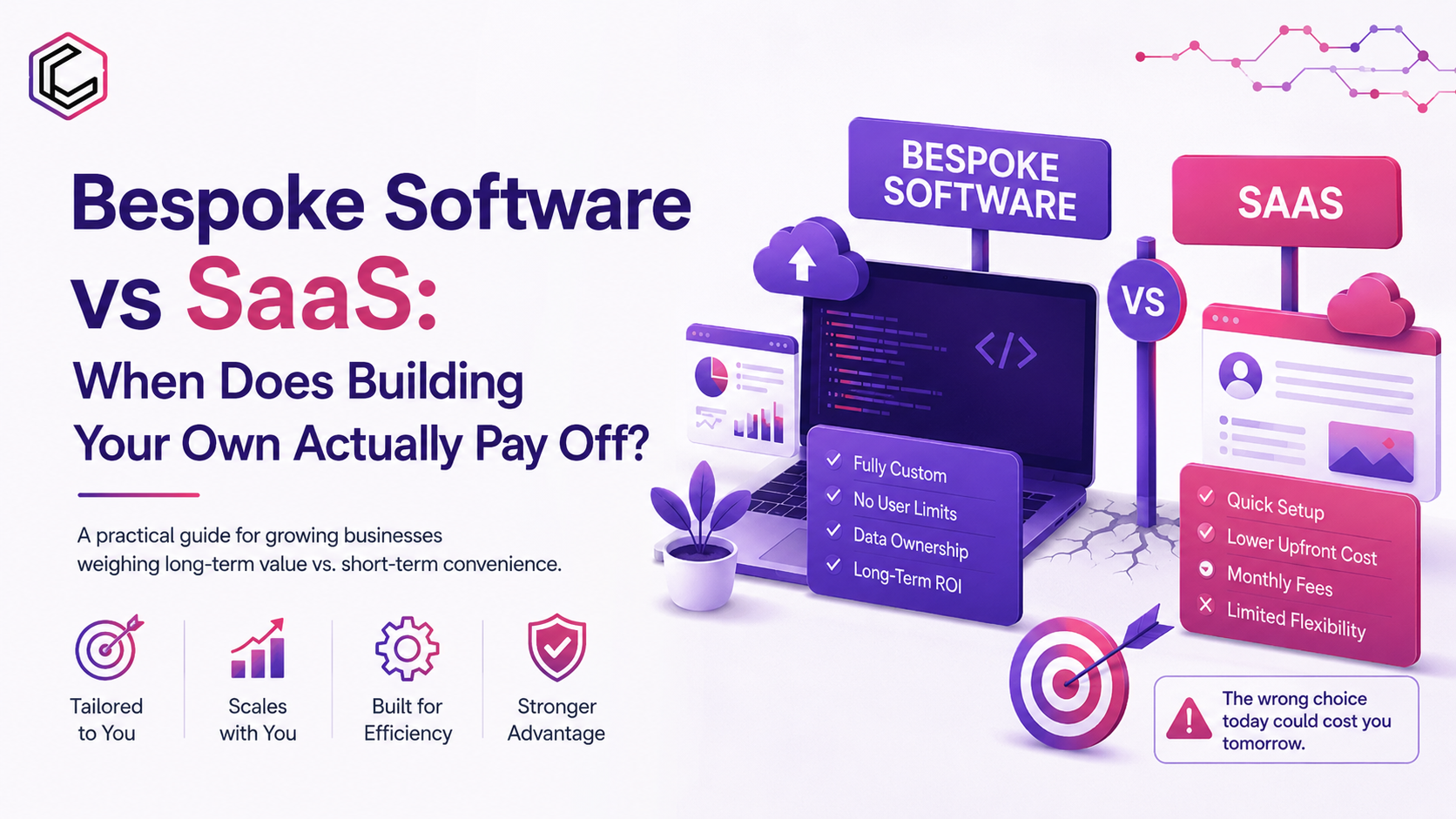
Bespoke software vs SaaS is a strategic decision that determines whether your technology serves your business model or forces your business to conform to someone else’s. Bespoke (custom-built) software is developed specifically for your organisation, while SaaS (Software as a Service) gives you access to a shared platform on a subscription basis. The right choice depends on your process complexity, growth trajectory, and whether a generic tool can actually do the job you need.
Bespoke vs SaaS at a Glance
Most UK founders approach this decision backwards. They default to SaaS because it is faster to start, then discover 18 months later that they are paying for five overlapping platforms, running manual workarounds in spreadsheets, and still missing the one feature that would genuinely move the needle.
The practical summary:
- SaaS wins when your need is standard, your team is small, and speed-to-market matters more than differentiation.
- Bespoke wins when your process is your competitive advantage, your SaaS stack has grown unwieldy, or you are handling data that cannot live in a third-party system.
According to Productiv’s SaaS Management Index, only 43% of purchased SaaS licences across enterprise organisations are actively used meaning the average business is funding capabilities it has never deployed, while still adapting its workflows to fit the constraints of those tools.
Factors That Determine Which Option Is Right for You
1. Process Complexity and Uniqueness
If your core business process can be mapped onto a standard SaaS template with minimal adjustment, that tool will serve you well. If you find yourself requesting workarounds from your SaaS provider, building integrations between four platforms just to replicate one workflow, or training staff to work around the software rather than with it your process has outgrown the product. A logistics company running complex multi-depot routing, for example, will never find an off-the-shelf tool that reflects its actual rules.
2. Total Cost of Ownership Over Three Years
SaaS looks cheap at month one. The calculation changes when you factor in per-seat pricing at scale, add-on modules, API call limits, integration middleware, and the consultancy cost of bending your workflows to fit the platform. Custom software development in the UK typically costs between £15,000 for a basic MVP and £250,000+ for a full enterprise system, depending on complexity, team size, and timeline but once built, the recurring cost is your hosting and maintenance, not a perpetually growing licence fee.
3. Data Sensitivity and Regulatory Exposure
Regulated industries financial services, healthcare, legal carry obligations that SaaS contracts frequently cannot satisfy. If your data residency requirements specify UK-only hosting, if you are subject to FCA oversight, or if your clients’ contracts restrict third-party data processing, putting sensitive records into a US-headquartered SaaS platform creates legal and commercial exposure. Bespoke software, hosted on infrastructure you control, eliminates that category of risk entirely.
4. Integration Debt Accumulation
Every SaaS tool you add to your stack creates an integration requirement. The average UK SME using five or more SaaS platforms has at least three fragile point-to-point integrations holding them together usually Zapier automations or manual CSV exports that break without warning. This is not a technology problem; it is an architecture problem caused by solving each workflow in isolation. A single bespoke system with a coherent data model eliminates the glue entirely.
5. Competitive Moat and IP Ownership
SaaS tools are, by definition, available to every one of your competitors on identical terms. If the software powering your operations is the same software your rival uses, your technology cannot be a source of advantage. Bespoke software is an asset you own the IP, you control the roadmap, and your competitor cannot replicate it by signing up for the same subscription.
6. Speed of the Decision vs Speed of the Return
SaaS can be live in hours. That speed is real and should not be dismissed. The question is whether you are optimising for the decision or for the outcome. A bespoke system from Capital Compute is typically delivered in 8–16 weeks for an MVP slower than signing up for a SaaS tool, but considerably faster than most founders expect, and structured so that the first usable version ships early.
How AI Changes the Bespoke vs SaaS Calculation in 2026
AI-assisted development has materially shifted the economics of building custom software and most founders have not updated their assumptions to reflect this. The traditional objection to bespoke software was always speed and cost. Both of those objections are weaker than they were 24 months ago.
The Old Objection: “Bespoke Takes Too Long”
A traditional development agency writing code manually spec, architect, build, test, deploy took 6–12 months to deliver anything production-ready. That timeline was a legitimate reason to choose SaaS for most teams. AI coding tools have collapsed that constraint. At Capital Compute, engineers work with Claude for architecture reasoning and code generation, Cursor for intelligent in-editor assistance, and GitHub Copilot and Codex for accelerating boilerplate and test coverage. The result is that work which previously took 12 weeks now ships in 6–8 weeks with higher test coverage, not lower.
The Old Objection: “Bespoke Is Too Expensive”
Development cost is largely a function of engineering hours. AI tooling reduces the number of hours required to produce production-quality code without reducing the quality of what ships. Capital Compute passes that efficiency directly to clients the same system that would have cost £80,000 at a traditional agency is now deliverable at a materially lower price point, or at the same price point with a significantly expanded scope. The unit economics of bespoke software are improving every quarter.
What AI Cannot Do for SaaS
The flip side is equally important to understand. AI tools improve the build side of the equation they do not fix the fit problem. A SaaS tool that does not match your workflow is still a SaaS tool that does not match your workflow, regardless of how many AI features the vendor bolts onto the product. Most SaaS platforms are now racing to add AI capabilities as retention features. Those capabilities are generic by definition trained on broad datasets, not on your business logic, your data, or your process. Custom AI features embedded in bespoke software, by contrast, can be trained and prompted on your specific context.
AI Features Built Into Your Bespoke System
Capital Compute builds AI functionality directly into bespoke systems where it creates genuine operational value. That means integrating models like Claude into your internal workflows not as a chatbot layer on top of your product, but as a reasoning engine embedded in your core process. Examples from live projects include: automated document classification for a legal operations team, intelligent job-matching logic for a recruitment platform, and anomaly detection embedded in a logistics dispatch system. Each of these is proprietary to the client and unavailable to their competitors.
The practical implication is this: if you are choosing between a generic SaaS platform with AI features and bespoke software with AI features designed for your specific use case, the comparison is no longer speed or cost it is whether you want AI that knows your business or AI that knows everyone’s business equally.
What to Watch Out For
The “we’ll build it later” trap. Founders often start with SaaS as a temporary measure and then discover that migrating off a deeply embedded platform two years later is more expensive than building right the first time would have been. If you suspect your process will not fit standard tooling within 12 months, the cost of delay compounds.
Agencies that quote low and expand late. A £20,000 fixed-price quote for complex software is almost always a commercial strategy, not a realistic estimate. Scope gaps become change requests; change requests become invoices. Scrutinise any quote that does not include a detailed technical specification as a deliverable in its own right.
Confusing “customisation” with “bespoke.” Most SaaS platforms offer configuration options they call customisation. Adding your logo and setting permission levels is not a custom system. If the underlying data model, workflow logic, or user experience cannot change, you are still constrained by the vendor’s architecture.
Ignoring the exit cost. Migrating data out of a SaaS platform is consistently harder than migrating data in. Before committing to a platform, establish what your data export looks like and whether you can take it with you. Several enterprise SaaS vendors make data portability deliberately difficult.
Underestimating internal change management. Bespoke software reflects how your team should work, which means your team needs to change how it currently works. Software without process redesign delivers less than half its potential value. Budget time and resource for adoption, not just delivery.
How Capital Compute Approaches This Decision
Capital Compute does not have a financial incentive to push you toward custom software. The first conversation is a structured evaluation which parts of your operation genuinely require bespoke tooling, and which could be served by a well-configured SaaS product you already pay for.
Where bespoke development is the right answer, Capital Compute’s delivery model uses an AI-assisted development stack Claude, Cursor, GitHub Copilot, and Codex that compresses timelines without compressing quality. Work that took a traditional agency 12 weeks to produce now takes 6–8 weeks at Capital Compute, with the same engineering rigour and significantly more test coverage. Clients receive full IP ownership from day one, with no lock-in to our infrastructure or team.
For UK founders evaluating this decision right now, the practical starting point is a free project estimate not a sales call, but a technical scoping session that tells you what your specific requirements would cost to build and how long delivery would realistically take.
Frequently Asked Questions
How do I know if my business is ready for bespoke software?
The clearest signal is that you are running three or more SaaS tools whose primary function is compensating for what the other tools cannot do. If you have a dedicated person managing data between platforms whether through Zapier, spreadsheets, or manual re-entry you are already paying for a custom integration layer. The question is whether you are paying for one that works. A secondary signal: if a competitor built the same internal tool, it would give them a material advantage over you.
Is bespoke software always more expensive than SaaS in the long run?
Not when you account for the full cost. Custom software development in the UK typically costs between £15,000 for a basic MVP and £250,000+ for a full enterprise system but the recurring cost after delivery is hosting and maintenance, not a per-seat licence that scales with your headcount. At 20 users paying £150/month per seat, a SaaS tool costs £36,000 per year. A £60,000 bespoke system breaks even in under two years and continues to appreciate as a business asset.
How long does bespoke software development take in the UK?
An MVP a production-ready system covering your core workflow typically takes 8–16 weeks with a capable development partner. Full enterprise systems with complex integrations take longer, but phased delivery means you have something usable well before the final version is complete. Capital Compute’s AI-assisted development stack consistently delivers MVPs in the lower end of that range.
Can bespoke software integrate with the SaaS tools we already use?
Yes, and this is often where bespoke software creates the most immediate value. A custom system with a well-designed API layer can connect to your CRM, accounting platform, and data warehouse in a way that is more reliable and more flexible than SaaS-to-SaaS integrations built on middleware. The difference is that the integration is designed rather than bolted on.
Closing
You now have a framework for making this decision that does not rely on assumptions. The core question is not “which is cheaper?” it is “which option allows my business to operate the way it actually needs to?” SaaS is the right answer more often than software agencies will tell you, and bespoke development is the right answer more often than SaaS vendors will admit. The honest version of this decision requires looking at total cost, workflow fit, data obligations, and your three-year growth trajectory not the monthly subscription price.
If you are evaluating custom software development partners for a UK project, Capital Compute offers a free 30-minute discovery call with a senior engineer, not a sales team.
